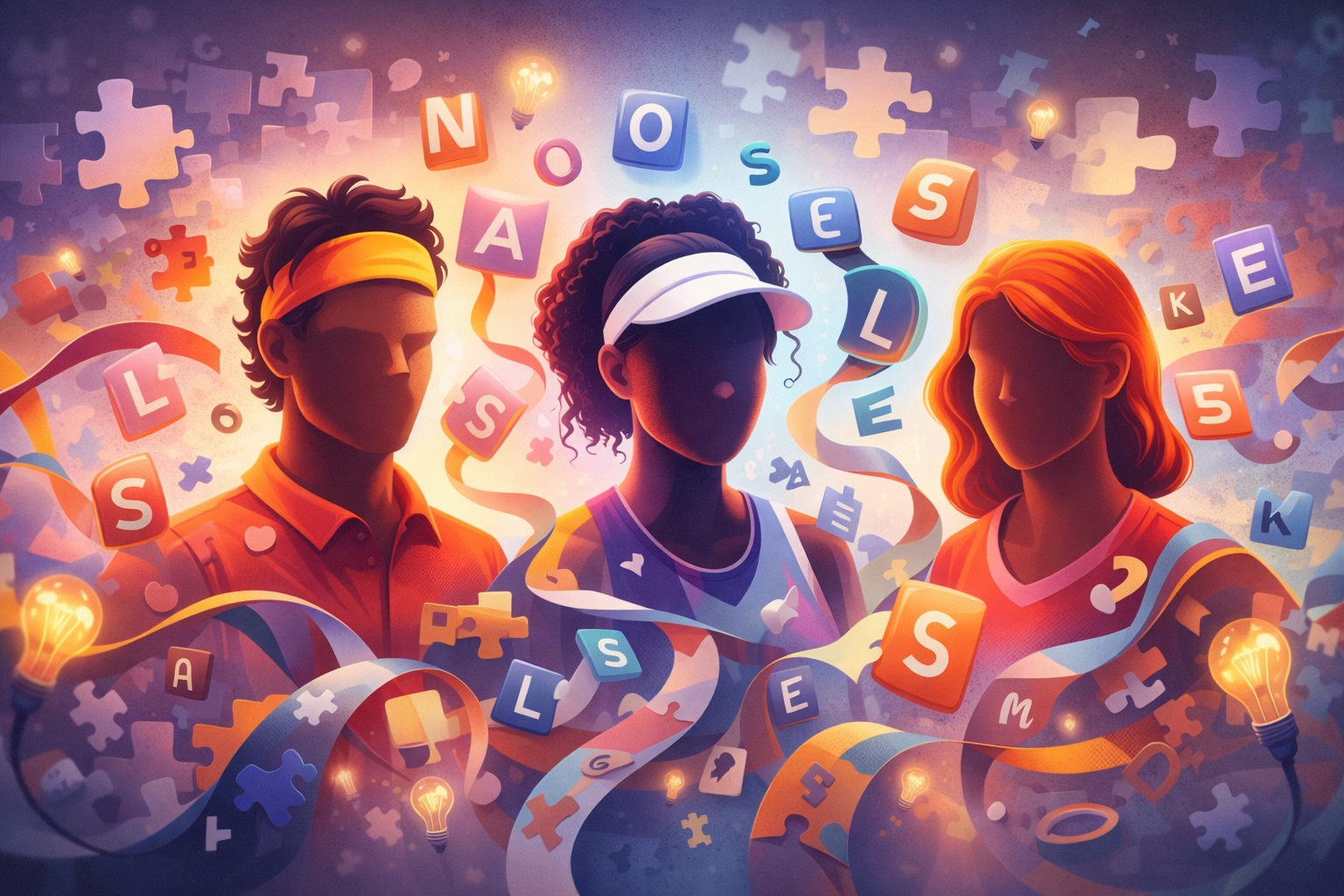
If you need a Connections hint for today’s puzzle, you landed in the right place. Nadal, Osaka, and Seles all appeared on the NYT Connections board for puzzle #1001 on Sunday, March 8, 2026. Three tennis legends staring back at you from the same grid. The trap was perfectly set. However, none of them belong together — and that is exactly what the puzzle wanted you to think.
This Connections hint will give you the full answer, the full explanation, and the full story behind each name. Because once you know the trick, you realize the puzzle was also quietly honoring three of the greatest athletes who ever picked up a racket.
Connections Hint Revealed: The Full Answer for Puzzle #1001
Here is the answer you came for. In today’s puzzle, Nadal, Osaka, and Seles each ended up in completely different categories. That deliberate misdirection is the hallmark of a great Connections puzzle.
All four categories for puzzle #1001 are:
Yellow — Cities: LIMA, NICE, OSAKA, PHOENIX
Green — Palindromes: EYE, REFER, ROTATOR, SELES
Blue — Horror Movies Minus “S”: GREMLIN, JAW, SINNER, TREMOR
Purple — Starting With Slang for Zero: JACKET, NADAL, SQUATTER, ZIPPER
So OSAKA is a major city in Japan. SELES is a palindrome — it reads identically forwards and backwards. And NADAL starts with “nada,” which is Spanish slang for zero. None of them are grouped as tennis players because there is no tennis category in today’s puzzle at all.
Moreover, SINNER is also on the board — another active tennis star — but he belongs in the horror movies category because “Sinners” minus the S becomes SINNER. That is the kind of layered trickery that makes this puzzle so satisfying — and so infuriating. Now that you have your Connections hint, here is why each name deserves a much closer look.
Nadal: The Man Who Refused to Break
Rafael Nadal was born in Manacor, Mallorca, Spain in 1986. He turned professional at 15. By 19, he had already won his first French Open title. However, what followed over the next two decades was not just a tennis career — it was one of the most remarkable stories of resilience in the history of sport.
Nadal won the French Open 14 times. That record is almost impossible to put into context. Furthermore, he collected 22 Grand Slam titles in total — a number that places him alongside Novak Djokovic and Roger Federer in the greatest-of-all-time conversation. On clay, he was simply untouchable. His record at Roland Garros stands at 112 wins and just four losses over his entire career.
Behind the trophies, though, was a body under constant assault. Nadal battled Müller-Weiss syndrome — a rare degenerative condition in his foot — for most of his career. On top of that, he suffered repeated knee, hip, and abdominal injuries that forced him off the tour for long stretches. Still, he kept coming back. Each return felt less like a sports story and more like a lesson in what human willpower actually looks like.
He retired in November 2024 at age 38. His farewell was quiet and dignified — exactly like the man himself. In his final statement, he said tennis had given him more than he had ever dared to dream. He left the sport with his integrity perfectly intact and his legacy permanently secure.
I think about Nadal whenever people say talent is the most important thing. It is not. He proved that daily discipline and refusal to quit matter more than any natural gift.
Osaka: The Champion Who Changed the Conversation
Naomi Osaka was born in the city that shares her surname — Osaka, Japan — in 1997. She moved to the United States at age three and trained in Florida from childhood. Her rise to the very top of the sport was both rapid and breathtaking.
In 2018, she defeated Serena Williams — her childhood idol — in the US Open final to claim her first Grand Slam title. As a result, she became the first Japanese player, male or female, to win a Grand Slam singles event. She then backed it up immediately at the 2019 Australian Open, making her the first woman since Serena to win back-to-back major titles. By January 2019, she was ranked world number one at just 21 years old.
However, the bigger story came later. In 2021, Osaka withdrew from the French Open and cited mental health as her reason. That single decision sparked a global conversation about the psychological pressures placed on elite athletes. She later revealed she had been struggling with depression since her 2018 breakthrough. That honesty took real courage — and it changed how sports organizations across the world think about athlete wellbeing.
Furthermore, Osaka used her platform for something bigger than tennis. At the 2020 US Open, she wore face masks bearing the names of Black Americans killed by police violence. She boycotted a match in protest of racial injustice. She lit the Olympic flame at the Tokyo 2020 opening ceremony. Each of those moments showed a young woman who understood that her influence stretched far beyond the baseline.
Osaka has won four Grand Slam titles — two US Opens and two Australian Opens. She took maternity leave in 2023 after the birth of her daughter Shai and returned to the tour in 2024. She is still only 28 years old. In other words, her story is still being written.
Seles: The Legend Whose Career Was Stolen
Of the three names in today’s Connections hint, Monica Seles may be the least familiar to younger fans. However, her story is one of the most extraordinary and heartbreaking in sports history.
Seles was born in Novi Sad, Yugoslavia in 1973. She burst onto the tennis scene as a teenager with a style nobody had ever seen. She hit two-handed on both sides with explosive power and sharp angles. By age 19, she had already won eight Grand Slam titles and was ranked number one in the world. Many tennis historians believe she was on pace to become the most decorated player the sport had ever seen.
Then everything changed in an instant. On April 30, 1993, during a tournament in Hamburg, Germany, a deranged fan ran onto the court and stabbed Seles in the back with a knife. She was 19 years old.
The physical injury healed. Nevertheless, the psychological wound ran far deeper. Seles stayed away from professional tennis for more than two years. When she finally returned in 1995, she won the Australian Open — a comeback so remarkable it seemed almost fictional. Still, she later admitted she was never fully the same mentally. The joy the sport had once given her was never entirely restored.
Seles finished her career with nine Grand Slam titles. Most analysts believe she would have won 20 or more without the attack. She represents one of the great unanswerable questions in sports history — not just a “what if,” but a reminder that the dangers athletes face are not always on the scoreboard.
After retiring in 2008, Seles wrote a memoir called Getting a Grip about her battles with emotional eating and her search for peace. She became an American citizen in 1994 and lives a largely private life today. Nevertheless, she remains deeply respected within the tennis world and far beyond it.
The Real Connection Between Nadal, Osaka, and Seles
Now that you have the full Connections hint, it is worth stepping back. Because beyond the wordplay — city, palindrome, slang for zero — these three names share something genuine and profound.
All three are Grand Slam champions at the highest level. Together, Nadal, Osaka, and Seles account for 35 major titles. However, numbers alone do not explain why each of them matters so much.
Each one faced a moment where their career, their health, or their sense of self was in real danger. Nadal fought a degenerative bone disease for over a decade. Seles survived a violent attack that stole years from her prime. Osaka faced a mental health crisis at the peak of her powers and chose transparency over reputation — at great personal cost.
Furthermore, all three responded to their worst moments with a kind of grace that made them larger than sport. Nadal turned chronic pain into extraordinary perseverance. Seles turned trauma into a broader conversation about athlete safety. Osaka turned private suffering into public advocacy that genuinely shifted how the world thinks about mental health.
That is the connection the puzzle did not show you. Three people. Three different crises. Three different forms of courage.
Connections Hint for Tomorrow: How to Avoid the Trap
If today’s puzzle caught you out, here is the best piece of advice for tomorrow’s Connections hint hunt — the obvious grouping is almost always the trap.
When you see names that clearly belong together, slow down. Ask yourself whether each word has a second meaning. OSAKA is a tennis champion — but it is also a Japanese city. SELES is a sporting icon — but it is also a palindrome. NADAL is a legend — but it also starts with “nada,” which means nothing.
The puzzle writers are always one step ahead. However, now that you know the pattern, you are one step ahead of them.
Come back tomorrow for puzzle #1002 hints, answers, and the stories behind every name on the board.














Hello http://flashynews24.com,
While reviewing your website, I noticed a few issues that might be affecting your search rankings on Google.
I’ve prepared a short audit report with screenshots explaining the problems.
Would you like me to share it with you?
Thank you,
Alina