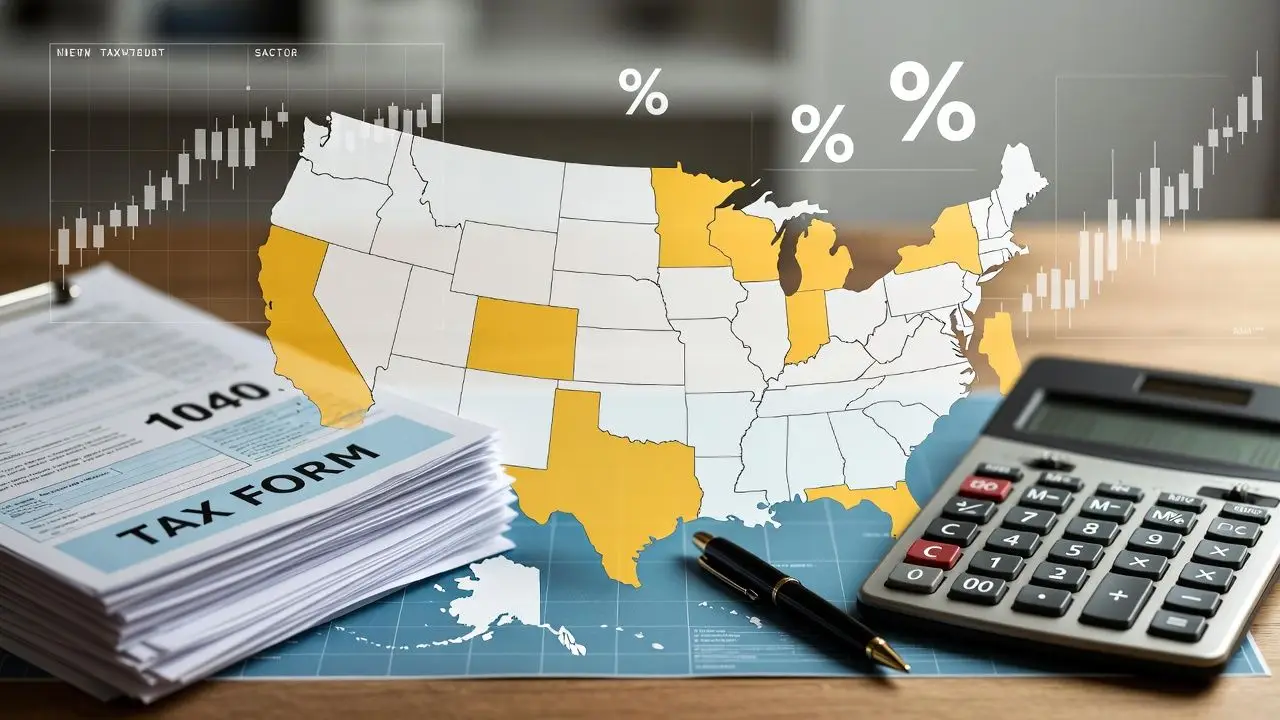
Forty-three states are ringing in 2026 with notable tax changes. Businesses face new compliance requirements. Planning must start now before April 15.
The changes affect individual income taxes, corporate rates, business property taxes, and more. Seven states remain unchanged this year. But most businesses will feel the impact.
Individual Income Tax Cuts Spread
Eight states reduce individual income tax rates in 2026. Georgia, Indiana, Kentucky, Mississippi, Montana, Nebraska, North Carolina, and Oklahoma all lower rates.
Ohio joins the flat-tax revolution. It becomes the 15th state with a single-rate personal income tax system. Buckeye taxpayers now pay 2.75% for all non-business income over $26,050.
Indiana’s flat rate drops from 3% to 2.95%. Further reductions to 2.9% hit in 2027. If revenue thresholds are met, the rate could eventually reach 2.55% by 2030.
These individual cuts affect business owners who pay personal income tax on pass-through entities. S-corps, LLCs, and partnerships benefit when owners face lower rates.
Corporate Income Tax Changes
Four states reduced corporate income tax rates. This provides direct relief to C-corporations operating in those jurisdictions.
Iowa maintains its current structure. Corporate rates stay at 5.5% for income up to $100,000 and 7.1% above that threshold. The state evaluated lowering rates but decided against it for 2026.
Delaware, Illinois, and Michigan all adjusted corporate tax conformity with federal law. These technical changes affect how businesses calculate state taxable income.
Business Property Tax Relief
Indiana dramatically expanded its business personal property tax exemption. The threshold jumped from $80,000 to $2 million.
This change eliminates filing requirements for thousands of small businesses. Administrative burden drops significantly. Cash flow improves when businesses don’t pay tax on equipment and machinery.
The homestead deduction changes complicate residential property calculations. But business owners see clear benefits from the personal property exemption increase.
Federal Conformity Complications
States must decide whether to conform to federal tax law changes. The One Big Beautiful Bill Act created major complications.
Some states automatically conform. Others selectively adopt or reject federal provisions. This creates complex compliance requirements.
Research and experimentation expense deductions exemplify the challenge. The OBBBA allows immediate expensing federally. But Delaware requires businesses to continue amortizing over five years.
California decoupled from federal clean energy credit provisions. Illinois changed dividend received deduction rules. Maine issued guidance but awaits formal legislation.
Businesses operating in multiple states face a compliance nightmare. Each state treats federal changes differently.
New Excise and Use Taxes
Maine increased cigarette taxes from $2.00 to $3.50 per pack. Smokeless tobacco and vaping taxes rose dramatically. Cannabis excise taxes decreased.
Nevada raised unemployment insurance taxable wage bases. New vehicle registration fees hit across the board. These changes affect business operating costs directly.
New Jersey enhanced its Angel Investor Tax Credit Program. Investment tax credits increased from 20% to 35%. Minority and women-owned businesses in Opportunity Zones can receive up to 40% credits.
Employment Tax Reporting Requirements
The OBBBA created new reporting obligations for employers. Businesses must now separately report tip income and overtime compensation on Forms W-2 and 1099-NEC.
Up to $25,000 in tip income becomes deductible for employees. Overtime pay deductions reach $12,500 for single filers and $25,000 for joint filers.
Employers must track and report these amounts accurately. Payroll systems require updates. Compliance costs increase.
1099-K Threshold Stays High
The OBBBA maintained the $20,000 and 200 transaction threshold for 1099-K reporting. The IRS had planned to lower it to $600 for 2026.
This provides major administrative relief. Businesses using third-party payment processors avoid excessive form generation. Gig economy workers benefit most.
However, income reporting obligations remain unchanged. Just because you don’t receive a 1099-K doesn’t mean income isn’t taxable.
State-by-State Variations
Seven states implemented no tax changes: Alaska, Massachusetts, New Mexico, North Dakota, South Carolina, South Dakota, and West Virginia.
These states provide stability. Businesses operating there face no new compliance requirements. Planning remains straightforward.
The remaining 43 states each changed something. Rates, exemptions, credits, deductions, or conformity rules shifted. No two states adopted identical changes.
What Businesses Must Do Now
Review state-specific changes immediately. Each jurisdiction where you operate requires individual analysis. Assumptions from 2025 won’t work in 2026.
Update accounting systems to track new reporting requirements. Tip income and overtime must be separately identified. Payroll providers need configuration changes.
Evaluate entity structure implications. Some businesses might benefit from converting between C-corps and pass-through entities. State-specific rate changes influence these decisions.
Businesses operating across state lines face the worst compliance burden. Each state’s unique treatment of federal changes creates chaos.
One business might have five different research and experimentation expense treatments across five states. Another faces varying dividend received deduction rules.
Tax software must handle these state-specific variations. But software updates lag legislation. Manual adjustments become necessary.
Professional Guidance Is Essential
The Tax Foundation publishes detailed state-by-state breakdowns. Their research helps businesses understand specific changes.
But general guidance isn’t enough. Each business faces unique circumstances. Industry-specific rules. State-specific operations. Entity structure considerations.
Engage tax professionals early. Waiting until March creates problems. Planning opportunities close. Compliance mistakes multiply.
The 2026 Filing Season Timeline
Tax season opens Monday, January 26, 2026. The IRS expects 164 million individual returns. Most will file electronically.
The deadline remains Wednesday, April 15, 2026. Extensions push the deadline to October 15 for businesses.
State deadlines vary but typically align with federal dates. Check each jurisdiction’s specific requirements.
The Bottom Line
Forty-three states changed tax laws for 2026. These changes affect business planning, compliance, and cash flow.
Individual rate cuts help business owners. Corporate rate reductions benefit C-corporations. Property tax exemptions reduce administrative burdens.
But federal conformity variations create complexity. New reporting requirements demand system updates. Multistate operations face enormous challenges.
Start planning now. Review each jurisdiction’s specific changes. Update systems. Engage professionals. Don’t wait until tax season arrives.
The changes are real. The compliance requirements are binding. Businesses that prepare now avoid penalties and optimize outcomes.