Over 530 million people worldwide live with diabetes. Many require daily insulin injections. The needles cause pain, fear, and frustration.
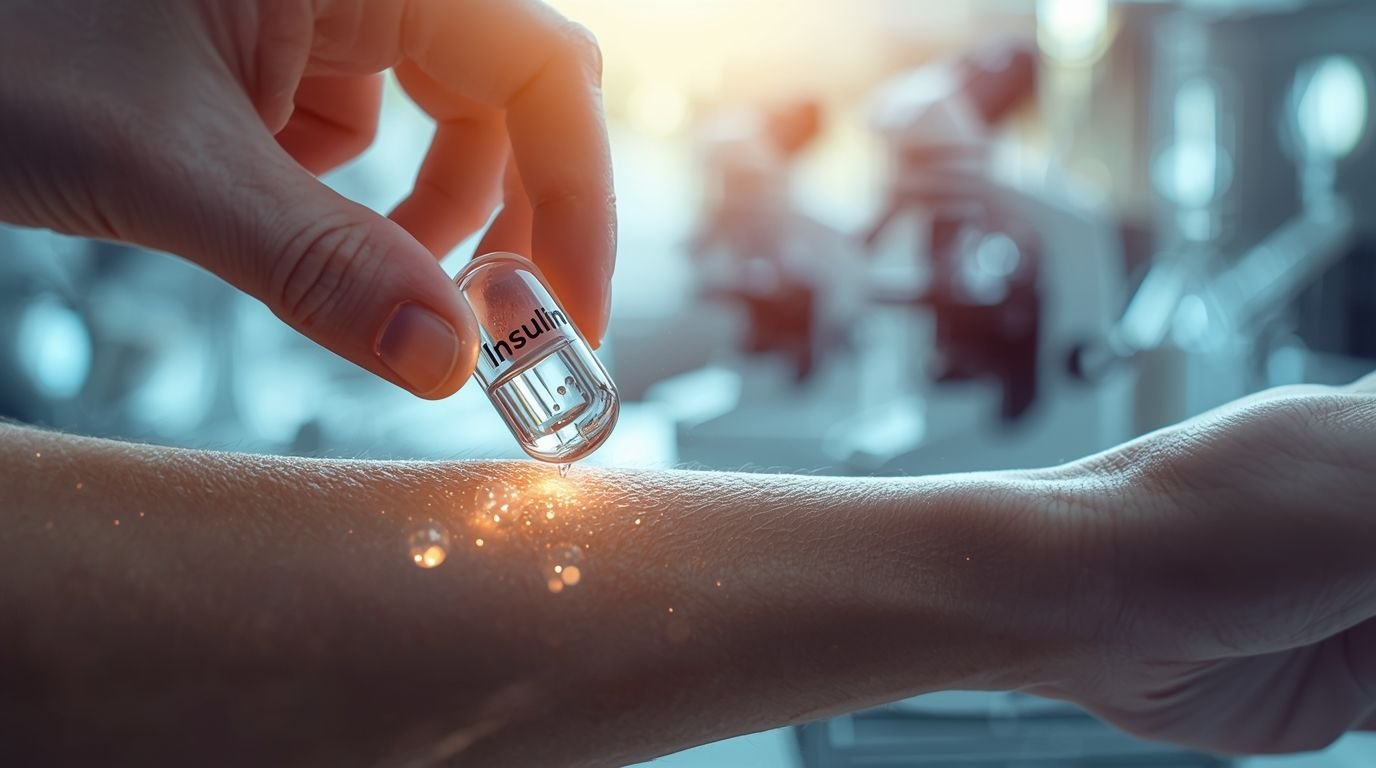
Now scientists have created something revolutionary. Needle-free insulin that works through your skin. No injections required.
The Breakthrough Polymer
Researchers at Zhejiang University developed a special polymer gel. It’s called OP, short for poly[2-(N-oxide-N,N-dimethylamino)ethyl methacrylate].
This polymer does something previously thought impossible. It carries insulin through intact skin and into the bloodstream.
The skin normally blocks large molecules. Insulin is too big to pass through. The outermost layer acts like a fortress.
But this polymer uses a clever trick. It exploits the skin’s natural pH changes.
How It Actually Works
Your skin has different acidity levels at different depths. The surface is mildly acidic. Deeper layers are neutral.
The polymer responds to these pH changes. At the acidic surface, it becomes positively charged. This helps it latch onto negatively charged skin lipids.
It slips between the oily barrier layers. A few layers deeper, where pH becomes neutral, the polymer switches to a neutral state.
Now it drifts freely through lower skin layers. Insulin attached to the polymer hitchhikes along. It reaches the bloodstream without needles.
The Animal Testing Results
Scientists tested the gel on diabetic mice and miniature pigs. Results were remarkable.
A single application lowered blood glucose to normal levels within one to two hours. That’s comparable to injected insulin.
But here’s the stunning part. Blood sugar stayed controlled for 12 hours. Traditional injections last only about 4 hours.
The pigs’ skin closely resembles human skin. The gel caused no irritation. No inflammation. Even after repeated applications.
Comparing to Current Methods
Daily insulin injections dominate diabetes management. They work but have serious drawbacks.
Needle phobia affects many patients. Pain reduces treatment compliance. Repeated injections cause skin complications.
Some people try insulin pumps. These require insertion and maintenance. They’re expensive. Not everyone can afford them.
Oral insulin doesn’t work. The digestive system destroys it before it can help.
The Dose Question
One concern remains. The effective dose. In mice, researchers needed very high doses initially. About 116 units per kilogram of body weight.
That’s far beyond typical human doses. This raised efficiency concerns.
But miniature pigs required much lower doses. Around 7.25 units per kilogram. That’s much more practical.
Since pig skin resembles human skin, this suggests the technology could work efficiently in people.
Beyond Just Insulin
The research team isn’t stopping at insulin. They’re testing the polymer with other medications.
Weight-loss drugs like Ozempic show promise. The active ingredient penetrates skin effectively using the same approach.
This could revolutionize drug delivery beyond diabetes. Many medications currently require injections. The polymer could make them needle-free.
GLP-1 analogs, therapeutic peptides, and other proteins are being explored. The possibilities are enormous.
What Needs to Happen Next
Human trials are the critical next step. Animal results are promising. But people use insulin for decades.
Long-term safety must be proven. The polymer shows no toxicity in animals so far. But humans need thorough evaluation.
Dosing precision requires refinement. Too little insulin doesn’t control blood sugar. Too much causes dangerous hypoglycemia.
Regulatory approval will take time. The FDA and other agencies must review extensive safety data.
The Market Impact
The needle-free insulin market is projected to explode. Current estimates suggest reaching billions in value by 2035.
Other needle-free approaches exist. Jet injectors use high pressure. Microneedle patches puncture skin minimally.
But these methods compromise skin integrity. They cause discomfort. They increase infection risk.
The polymer gel is truly non-invasive. It doesn’t damage skin. It doesn’t change skin structure. This makes it superior.