Over twenty of the world’s largest megaprojects reach completion in 2026. This represents a historic convergence. Decades of planning. Billions in investment. All finishing within months of each other.
These aren’t just buildings. They’re statements about what humanity can achieve.
Sagrada Família: 144 Years in the Making
Barcelona’s iconic basilica approaches completion. Construction began in 1882. Antoni Gaudí took over in 1883 after the original architect quit.
The central tower dedicated to Jesus Christ reaches 172.5 meters. This makes it Barcelona’s tallest structure. Twelve of eighteen towers already stand complete.
When finished, Sagrada Família becomes the world’s tallest church. The final sculptures and decorative details will continue into the 2030s. But the main structure completes in 2026.
This isn’t just architecture. It’s a testament to generational persistence.
NEOM: Saudi Arabia’s $500 Billion Future
NEOM represents the most ambitious urban project ever attempted. The budget approaches $500 billion. Some estimates suggest the total could reach $9 trillion.
The Line is NEOM’s centerpiece. A linear city stretching 170 kilometers through desert. Two parallel mirror-clad skyscrapers form a continuous building.
No cars exist here. No roads. Just high-speed driverless transit. Residents access everything within a five-minute walk.
The city runs entirely on renewable energy. Zero carbon emissions is the goal. AI, IoT, and robotics integrate into every component.
Major construction milestones hit in 2026. This tests whether sustainable mega-cities are actually possible.
Danjiang Bridge: Record-Breaking Span
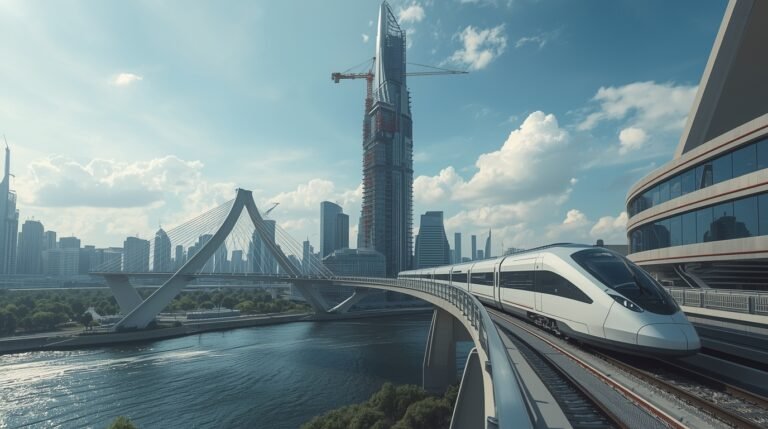
Taiwan’s Danjiang Bridge becomes the world’s longest single-pylon, asymmetric cable-stayed bridge. Construction began in 2019. The final deck segment was installed in October 2025.
The longest section spans 450 meters. A single 200-meter concrete pylon supports everything. Asymmetrical cables radiate from this central tower.
The design resists extreme weather and earthquakes. Zaha Hadid Architects created the slenderest possible silhouette. They wanted to preserve sunset views over the Tamsui River.
The bridge opens in May 2026. It connects major highways and reduces traffic congestion dramatically.
Extremely Large Telescope: Seeing 15 Times Farther
High in Chile’s Atacama Desert, the ELT nears operational readiness. The primary mirror spans 39 meters. Nearly 800 hexagonal segments move independently with extreme precision.
This telescope will gather fifteen times more light than current observatories. It will analyze exoplanet atmospheres directly. It will observe early galaxy formation. It will test dark matter theories.
Chile cements its position as the world’s premier ground-based astronomy location. The European Southern Observatory leads this $1.5 billion project.
California High-Speed Rail: America’s Speed Revolution
California’s high-speed rail continues despite massive challenges. Construction is active along 119 miles in the Central Valley.
Eighty-six of 92 structures are in progress or complete. Seventy miles of guideway stand finished. The project secured 99% of required property.
Governor Newsom’s 2026 budget ensures $1 billion annually through 2045. That’s nearly $20 billion over two decades.
Initial estimates were $33 billion. Current projections exceed $135 billion. But the first operational segment approaches reality.
Tour F: Africa’s New Tallest Building
Abidjan, Ivory Coast welcomes Africa’s tallest building. Tour F rises 1,381 feet across 64 stories. It surpasses Egypt’s Iconic Tower by less than 100 feet.
Lebanese Ivorian architect Pierre Fakhoury designed this administrative tower. It’s been part of city plans for over 50 years. Political upheaval delayed construction repeatedly.
But now it stands. A symbol of Ivory Coast’s stability and ambition.
Boeing 777X: Aviation’s Next Generation
The Boeing 777X prepares for airline service. Carbon-fiber wings with folding tips fit existing airport gates. GE9X engines deliver record thrust and fuel efficiency.
Deliveries begin around 2026. This aircraft influences long-haul travel for decades. Airlines can fly farther with lower fuel costs.
The 777X represents Boeing’s answer to Airbus’s A350. Competition drives innovation.
Milano Cortina 2026 Winter Olympics
The Winter Olympics showcase multiple architectural achievements. The Olympic Village by Skidmore, Owings & Merrill transforms a former rail yard.
Six new buildings plus two restored historic structures create a porous urban block. It integrates with surrounding Porta Romana district through public pathways.
After the Olympics, it becomes student housing. This dual-purpose approach sets new standards for Olympic legacy planning.
David Chipperfield Architects designed the Winter Olympics Arena. It accommodates 16,000 visitors. Post-Olympics, it hosts major sports and cultural events.
Shanghai Grand Opera House: Destination for Everyone
Snøhetta’s Shanghai Grand Opera House completes as part of China’s 13th Five-Year Plan. Located in the Expo Houtan district, it aims to be “a destination for everyone.”
The sweeping roof integrates artists and the public. The radial landscape design connects to the surrounding riverbank.
Traditional concerts share space with experimental performances. The goal is reaching wide audiences beyond classical music enthusiasts.
Akkuyu Nuclear Plant: Turkey’s Energy Transition
Turkey’s first nuclear power plant enters service. Four reactors will deliver a combined 4.8 gigawatts when fully operational.
The first unit goes live in 2026. This marks Turkey’s transition into nuclear power generation. It reduces long-term reliance on imported fuels.
Russia’s Rosatom constructed the facility. Turkey operates it under a build-own-operate model. This represents strategic energy independence.
NEOM Green Hydrogen Project: Clean Fuel Future
Powered entirely by renewables, NEOM’s hydrogen facility nears completion. It produces hydrogen for export and industrial use.
This positions NEOM as a key node in future global clean fuel networks. Hydrogen replaces fossil fuels in heavy industry and transportation.
The facility demonstrates that large-scale green hydrogen production is commercially viable. Other nations watch closely.
King Abdullah Economic City: $100 Billion Vision
KAEC spans 173 square kilometers on Saudi Arabia’s Red Sea coast. Founded in 2006, it aims to create one million jobs.
The projected total cost reaches $100 billion. The city diversifies Saudi economy beyond oil. It includes a massive port, industrial zones, residential areas, and tourism facilities.
Over 100 firms established presence. Road, rail, and sea connectivity was prioritized from day one.
The convergence effect is powerful. Better technology enables more applications. More applications generate more data. More data attracts more investment.
2026 marks an inflection point. Science reaches deeper space. Cities rise taller. Transport networks reconnect regions. Energy systems shift toward cleaner sources.
These megaprojects deliver capability, not just structures. They show what sustained planning and disciplined engineering achieve.
The future isn’t arriving gradually. It’s arriving all at once. Twenty years of work across multiple continents finishes within months.
Witness history. These engineering feats redefine what’s possible.