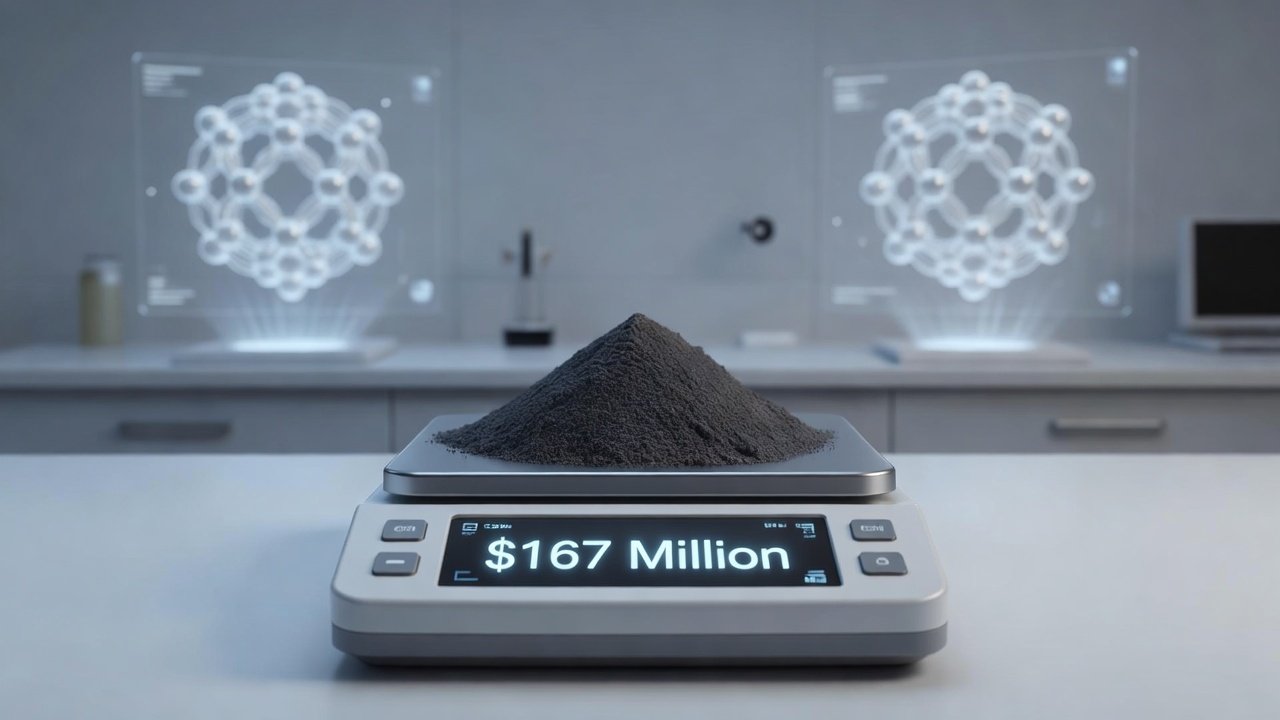
Scientists have created the most expensive material on Earth. It’s not gold. It’s not diamonds. It’s something you’ve probably never heard of.
This remarkable substance costs $167 million per gram. That’s more than your smartphone, your car, and your house combined. In fact, it’s more expensive than most things you can imagine.
What Is This Mysterious Material?
The material is called nitrogen atom-based endohedral fullerenes. That’s quite a mouthful. Scientists sometimes call it N@C60 for short.
Only two companies in the world can produce this extraordinary substance. Designer Carbon Materials, based at Oxford University in the UK, is one of them. They’re pioneers in creating this revolutionary material.
The material looks like ordinary salt or powder. But appearances can be deceiving. This tiny pinch is worth millions.
The First Sale That Shocked the World
In 2015, Designer Carbon Materials made their first sale. They sold just 200 micrograms of the material. That’s one-fifteenth the weight of a snowflake. It’s one-third the weight of a single human hair.
The price tag? A staggering £22,000, or about $33,400.
This tiny amount was so valuable that Oxford University warned handlers not to sneeze near it. One accidental breath could blow away millions of dollars.
How Is It Made?
Creating endohedral fullerenes is incredibly complex. The material consists of a cage made from 60 carbon atoms. Inside this cage sits a single nitrogen atom.
Think of it like a soccer ball. The carbon atoms form hexagons and pentagons, just like the pattern on a football. But instead of air inside, there’s a nitrogen atom.
This structure is named after architect Buckminster Fuller. He designed geodesic domes with similar interlocking triangles. Scientists affectionately call these molecules “buckyballs.”
Designer Carbon Materials can produce about half a gram per day. But that’s the lower quality version. The premium N@C60 takes much longer. They can only make 50 milligrams daily. Then it requires weeks of purification.
Why Is It So Expensive?
The astronomical price comes from extreme rarity and difficulty. Only two companies worldwide can make it. The production process is extraordinarily complex. Purification takes weeks of painstaking work.
The demand far exceeds supply. After the first sale, Designer Carbon Materials received requests from around the world. Scientists desperately want this material for groundbreaking research.
Dr. Kyriakos Porfyrakis founded Designer Carbon Materials. He’s been working on this material since 2001. That’s over two decades of dedicated research.
What Makes It Special?
Endohedral fullerenes have unique properties. The nitrogen atom trapped inside gives the material an unusually long electron spin lifetime. This special characteristic opens up revolutionary possibilities.
The material could transform how we measure time. It could revolutionize navigation systems. It might even change how we build smartphones.
Current atomic clocks are massive. They fill entire rooms. These clocks are incredibly accurate but completely impractical for everyday use.
Endohedral fullerenes could change everything. Scientists believe they can create atomic clocks the size of a computer chip. These tiny clocks could fit inside your smartphone.
The Future of Navigation
Imagine having an atomic clock in your pocket. Your smartphone could track your location with millimeter precision. Not meters. Not centimeters. Millimeters.
This level of accuracy would revolutionize autonomous vehicles. Self-driving cars need to know exactly where they are. Current GPS systems aren’t precise enough.
If two autonomous cars approach each other on a narrow road, knowing their position within 2 meters isn’t enough. But knowing within 1 millimeter? That’s game-changing.
The technology would work even in areas with weak GPS signals. Tunnels, underground parking, dense urban areas – all would become navigable. The atomic clock would maintain accuracy regardless of signal strength.
More Than Just Navigation
The applications extend far beyond cars and phones. Scientific research could benefit enormously. Medical imaging could become more precise. Communication networks could improve dramatically.
Quantum computing represents another frontier. Endohedral fullerenes could serve as quantum information storage elements. These are called qubits in quantum computer systems.
The long electron spin lifetime makes them ideal for this purpose. They remain stable for extended periods. This stability is crucial for quantum computing applications.
The Competition: What Else Is Expensive?
Endohedral fullerenes aren’t the only expensive material on Earth. Several other substances command astronomical prices.
Blue diamonds cost about $19 million per gram. These rare gems contain boron impurities. They’re found in only a handful of mines worldwide.
Californium-252 costs between $10 million and $27 million per gram. This radioactive element is created artificially. Scientists use it in nuclear reactors and cancer treatments.
Painite, an extremely rare gemstone, costs around $300,000 per gram. Only about 1,000 painite crystals exist in the entire world.
NASA’s asteroid samples from the OSIRIS-REx mission cost approximately $9.6 million per gram. The mission collected 120 grams of material from asteroid Bennu. The total mission cost topped $1.1 billion.
The Ultimate Champion: Antimatter
Only one material theoretically costs more than endohedral fullerenes. That material is antimatter.
Antimatter is the mirror image of ordinary matter. When matter and antimatter meet, they annihilate each other. They release enormous energy.
Creating antimatter is extraordinarily difficult. The particle accelerator at CERN produces 10 million antiprotons per minute. That sounds impressive. But at that rate, producing one gram would take billions of years.
The estimated cost? Between $59.8 trillion and $65.5 trillion per gram. That’s more than the entire U.S. economy.
However, antimatter isn’t commercially available. No company sells it. Endohedral fullerenes hold the practical crown as Earth’s most expensive purchasable material.
The Oxford Connection
Designer Carbon Materials spun out of Oxford University. The university’s Materials Science Department pioneered research into fullerenes.
The Carbon Nanomaterials Group at Oxford continues advancing the field. They work with various fullerene species beyond just C60. Their expertise includes large-cage fullerenes and rare earth endohedral metallofullerenes.
This deep research background enables Designer Carbon Materials to produce such high-quality products. Years of academic research translated into commercial production.
Market Demand and Future Prospects
Demand for endohedral fullerenes continues growing. Research institutions worldwide want samples. Tech companies see revolutionary potential. The market is expanding rapidly.
Dr. Porfyrakis confirmed increasing demand after the first sale. “We’re a new company, only starting to sell the product,” he said. “But after the first sale we have more requests from around the world.”
The company remains the only producer of premium N@C60. This monopoly position ensures prices stay high. But it also means they control a technology that could transform multiple industries.
The Path to Pocket-Sized Atomic Clocks
We’re still several years away from atomic clocks in smartphones. The technology requires further development. Manufacturing must scale up significantly.
But the consortium of UK and US researchers is working hard. They purchased those first samples to advance the research. Progress continues steadily.
“Imagine a miniaturized atomic clock that you could carry around in your smartphone,” Dr. Porfyrakis told The Telegraph. “This is the next revolution for mobile.”
Lucius Cary, director of the Oxford Technology SEIS fund, holds a stake in Designer Carbon Materials. He sees enormous potential. “At the moment, atomic clocks are room-sized,” he explained. “This endohedral fullerene would make it work on a chip that could go into your mobile phone.”
Investment and Innovation
The Oxford Technology SEIS fund invested in Designer Carbon Materials early. This investment supports continued research and development. It helps scale production capabilities.
Creating breakthrough materials requires significant capital. Research, equipment, and skilled personnel cost money. The high price per gram helps fund continued innovation.
As production increases, costs may eventually decrease. Economies of scale could make the material more accessible. But for now, it remains extraordinarily expensive.
Carbon’s Versatility
Carbon is the most versatile element in nature. It can form countless different structures. Diamond, graphite, and fullerenes are all pure carbon. Yet they have completely different properties.
This versatility enables buckyballs to exist. The 60 carbon atoms arrange themselves into a perfect sphere. The structure is stable yet capable of trapping other atoms inside.
Scientists continue discovering new forms of carbon. Each new discovery potentially unlocks new applications. The fullerene family keeps growing.
Beyond Earth Applications
Some researchers envision space applications. Highly accurate timekeeping is crucial for space navigation. Compact atomic clocks could improve spacecraft guidance systems.
Deep space missions require precise navigation. Traditional atomic clocks are too large and heavy. Chip-sized alternatives would be revolutionary.
Interplanetary travel demands extreme accuracy. Small timing errors accumulate over vast distances. Better clocks mean safer, more efficient space missions.
The Broader Context
Endohedral fullerenes represent human ingenuity at its finest. Scientists took fundamental carbon atoms and created something entirely new. They trapped nitrogen atoms inside carbon cages.
This achievement required decades of research. It demanded sophisticated equipment. It needed brilliant minds working together.
The result is a material that could transform technology. From smartphones to self-driving cars to quantum computers, the applications seem limitless.
The Price of Progress
At $167 million per gram, endohedral fullerenes aren’t for everyone. Only well-funded research institutions and major corporations can afford them.
But breakthrough technologies often start expensive. Early computers filled rooms and cost millions. Now everyone carries one in their pocket.
The same pattern may repeat with endohedral fullerenes. Today’s astronomical price could become tomorrow’s affordable technology.
Looking Forward
The future of endohedral fullerenes looks promising. Research continues advancing. Production methods improve. Applications multiply.
One day, your smartphone might contain atomic clock technology worth more than the phone itself. Your autonomous vehicle might navigate with millimeter precision. Quantum computers might revolutionize computing.
All of this potential exists because scientists created the world’s most expensive material. They trapped nitrogen atoms inside carbon cages. They unlocked extraordinary properties.
The material that costs more than gold, diamonds, and platinum combined could reshape our technological future. And it all starts with a powder that looks like salt.