The US economic slowdown is now official. Fresh government data confirms that growth dropped sharply in the final months of 2025 — and early signs suggest 2026 is not starting much stronger. So is America heading into a recession? Or is this just a speed bump on the road to recovery? The answer, as always, depends on which numbers you look at and who you ask.
Here is a clear, honest breakdown of what the latest economic data actually shows, what is driving the slowdown, and what it means for everyday Americans going forward.
US Economic Slowdown Confirmed: The GDP Numbers
The clearest signal of the US economic slowdown came on February 20, 2026. The Commerce Department released its advance estimate for fourth-quarter 2025 GDP — and the number surprised almost everyone on the downside.
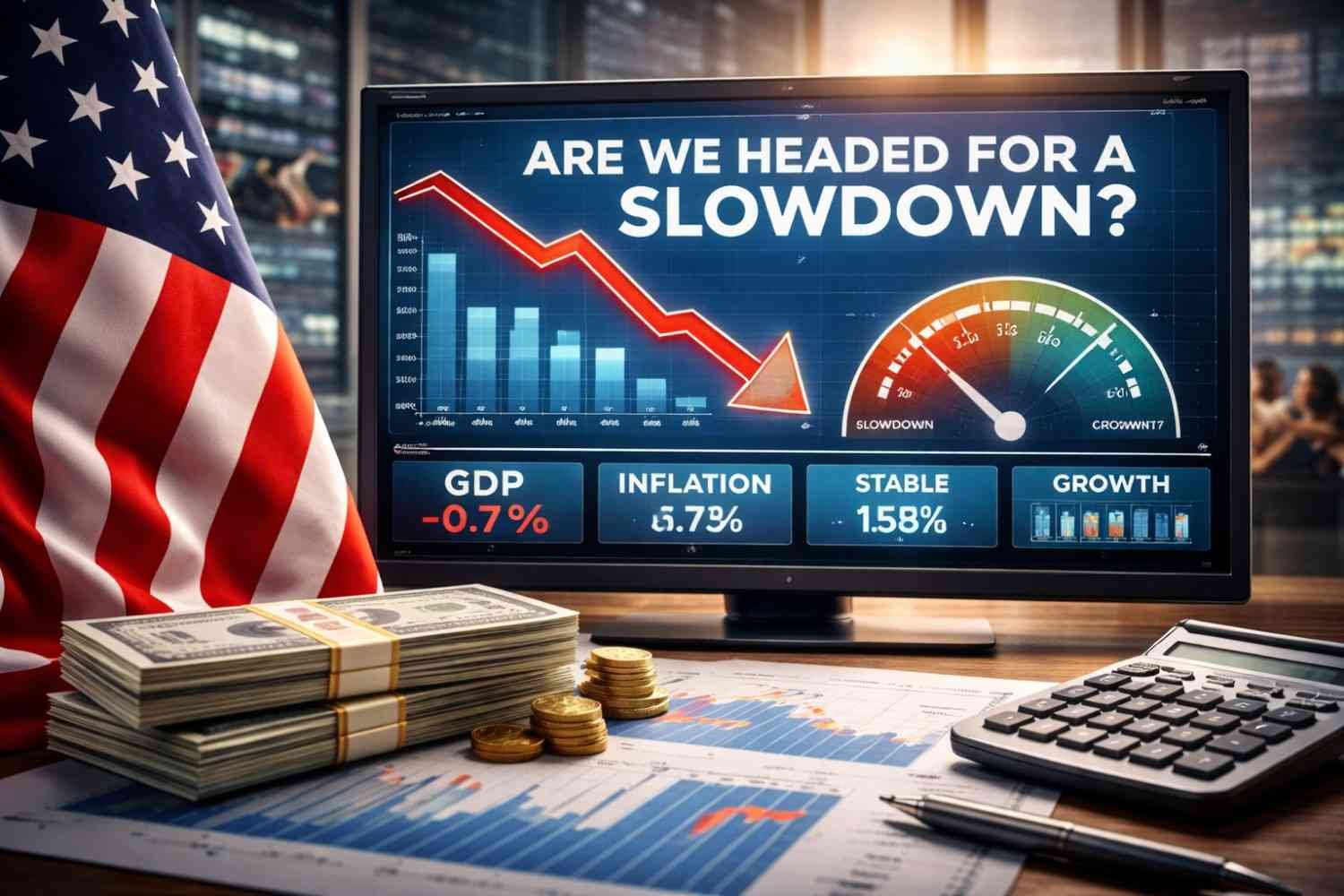
According to the Bureau of Economic Analysis, the economy grew at an annualized rate of just 1.4% in the fourth quarter of 2025. That is a dramatic drop from the 4.4% growth rate recorded in the third quarter. Moreover, it came in well below the 1.9% rate that economists had projected beforehand.
For the full year 2025, the US economy grew by 2.2%. While that sounds reasonable on the surface, it was actually the weakest annual growth rate since 2020 — the year the pandemic hit. In other words, the economy has been quietly losing momentum for longer than most headlines suggested.
Not all of that slowdown was organic, however. A significant chunk of it was caused by the federal government shutdown in late 2025. According to the report, the shutdown shaved off roughly 1.1 percentage points from fourth-quarter growth on its own. Still, even accounting for that, the underlying numbers are softer than many economists would like to see.
What Caused the US Economic Slowdown?
Several forces combined to produce this US economic slowdown, and understanding each one separately is important. They do not all carry the same weight or staying power.
The government shutdown was the single biggest near-term drag. Federal spending fell at a 1.15% annualized rate in the fourth quarter, according to the Bureau of Economic Analysis. Contractors, local businesses, and communities that depend on federal workers all felt the pinch. As a result, much of that lost growth is expected to bounce back in early 2026 as normal operations resume.
Consumer spending also wobbled at the end of 2025. Personal spending on goods fell — only marginally, but it was the first such decline since the first quarter of 2024. That shift is worth watching closely, because consumer spending typically accounts for about 70% of US economic activity. When shoppers pull back even slightly, the ripple effects spread quickly.
Tariffs are playing a growing role too. According to the Stanford Institute for Economic Policy Research, the best available evidence suggests tariff costs are now passing through to consumers at a rate exceeding 50%. Goldman Sachs projects that the current tariff regime will raise inflation by roughly 1% between the second half of 2025 and the first half of 2026. That kind of price pressure squeezes household budgets and slows spending over time.
Housing remains a persistent weak spot. Residential investment was a drag on the economy throughout all of 2025. High mortgage rates, which only recently dipped below 6.3% after staying above 7% for much of the year, have kept many buyers on the sidelines. Furthermore, residential building permits dropped nearly 10% year over year in August, signaling that the supply of new homes will remain tight well into 2026.
The Job Market: Slowing but Not Collapsing
One of the more confusing parts of the current US economic slowdown is the labor market. On one hand, unemployment is still relatively low. On the other hand, the pace of job creation has dropped sharply — and some analysts believe even the official numbers are overstated.
US employers added just 181,000 jobs in all of 2025, compared to more than 1.4 million the year before. That is a staggering drop. In January 2026, hiring picked up slightly with 130,000 jobs added. However, most of those gains came from healthcare — an industry that tends to add workers in good times and bad, making it a less reliable signal of broader economic health.
Meanwhile, Fed Chair Jerome Powell recently stated that he believes payroll employment growth has been overstated in recent data, and that revised figures may show the US has actually been losing jobs since April 2025. If that turns out to be true, the labor market picture is considerably more fragile than headline numbers suggest.
The unemployment rate, for its part, drifted from 4.1% to 4.4% over the course of 2025, according to the Stanford Institute for Economic Policy Research. That rise indicates labor demand weakened by more than labor supply — not a catastrophic shift, but a clear downward trend nonetheless.
Inflation: Still Too High, Still Sticky
Even as growth slows, inflation has not cooperated by falling back to the Fed’s 2% target. That combination — slower growth plus stubborn inflation — is what makes the current economic moment particularly tricky to navigate.
S&P Global’s latest PMI data shows that prices charged for goods and services rose at an increased rate again in February 2026. Business confidence, meanwhile, remains subdued. Companies are worried about the political environment and the ongoing impact of tariffs on both their costs and their customers’ willingness to spend.
The Federal Reserve, as a result, finds itself in a difficult position. Normally, a slowing economy would push the Fed to cut interest rates to stimulate growth. However, with inflation still running above target, aggressive rate cuts risk reigniting price pressures. According to Deloitte’s US Economic Forecast, the Fed is likely to hold rates steady until December 2026, with the federal funds rate not reaching its neutral level until mid-2027.
That means borrowing costs for mortgages, car loans, credit cards, and business loans will stay elevated for longer. For everyday Americans already stretched thin by high prices, that is yet another headwind.
The Wealth Gap Is Growing Inside the Slowdown
One of the most troubling aspects of the current US economic slowdown is not the overall numbers — it is who is feeling the pain most sharply. The economy is not slowing equally for everyone.
A University of Michigan consumer sentiment report released alongside the GDP data painted a stark picture. Sentiment among the largest stockholders rose sharply in February. At the same time, sentiment among consumers without stock holdings fell. Similar divergences showed up across income and education levels, with higher-income and college-educated consumers feeling better about the economy while lower-income counterparts felt worse.
That split economy is not a new phenomenon. Still, it is deepening. Rising asset prices are making the wealthy feel richer, while tariff-driven inflation and slower job growth are squeezing those at the bottom. As a result, national economic averages increasingly hide more than they reveal about what is actually happening in American households.
The Debt Bomb Ticking in the Background
Beyond the immediate data, a longer-term threat looms over any discussion of the US economic slowdown. Federal debt outstanding is on track to eclipse the entire size of the US economy in 2026 for the first time since World War II, according to KPMG’s January 2026 Economic Compass.
On top of that, the Congressional Budget Office has revised its Social Security projections downward. Because of declining immigration and lower birth rates, the point at which Social Security revenues can no longer cover benefits has been moved forward from 2034 to 2030. That is a four-year acceleration in a fiscal crisis that will affect tens of millions of Americans.
Bond markets have already picked up on these risks. Yields on long-term US Treasuries have risen even as the Fed has cut short-term rates — an unusual pattern that signals investors are demanding more compensation to hold US government debt. Gold, meanwhile, has regained its luster as a safe haven, partly at the expense of Treasuries.
Is a Recession Coming?
That is the question everyone wants answered. So far, the honest answer is: probably not immediately, but the risks are real and growing.
The US Chamber of Commerce notes that slower growth is not the same as a recession. A recession technically requires the economy to contract for six consecutive months — and that is not what the data currently shows. Instead, what we have is an economy growing below its potential, with several vulnerabilities that could tip it into contraction if external shocks hit at the wrong time.
Those shocks could come from several directions. A sharper-than-expected pullback in consumer spending, a new escalation in tariff policy, a financial market correction, or a geopolitical event could all knock an already slowing economy off balance. The Fed, the CBO, and the IMF all outline scenarios ranging from a soft landing to a deeper downturn — and which path materializes will depend heavily on policy decisions made in the coming months.
For now, AI investment remains a genuine bright spot. Business investment in data centers, computing infrastructure, and AI technology kept GDP from falling even further in the fourth quarter. Economists at NPR describe it as “a bright, shining star that should continue to shine brightly in 2026.” That optimism is warranted — as long as investment holds up.
What This Means for You
The US economic slowdown may not feel like a crisis yet. However, it is already showing up in the lives of ordinary Americans — in mortgage rates that remain stubbornly high, in grocery prices that keep climbing, in a job market where getting hired takes longer than it used to.
The smartest move right now is to pay attention to the monthly data as it comes in. Watch the payroll numbers. Track consumer spending. Follow what the Fed says at each meeting. Those data points will tell you far more about where the economy is headed than any single forecast.
The bottom line is this: the US economic slowdown is real, it is being driven by several overlapping forces, and it is not going away quickly. Whether it deepens into something more serious depends on choices that are still being made in Washington — and on an American consumer who, so far, has refused to stop spending entirely.