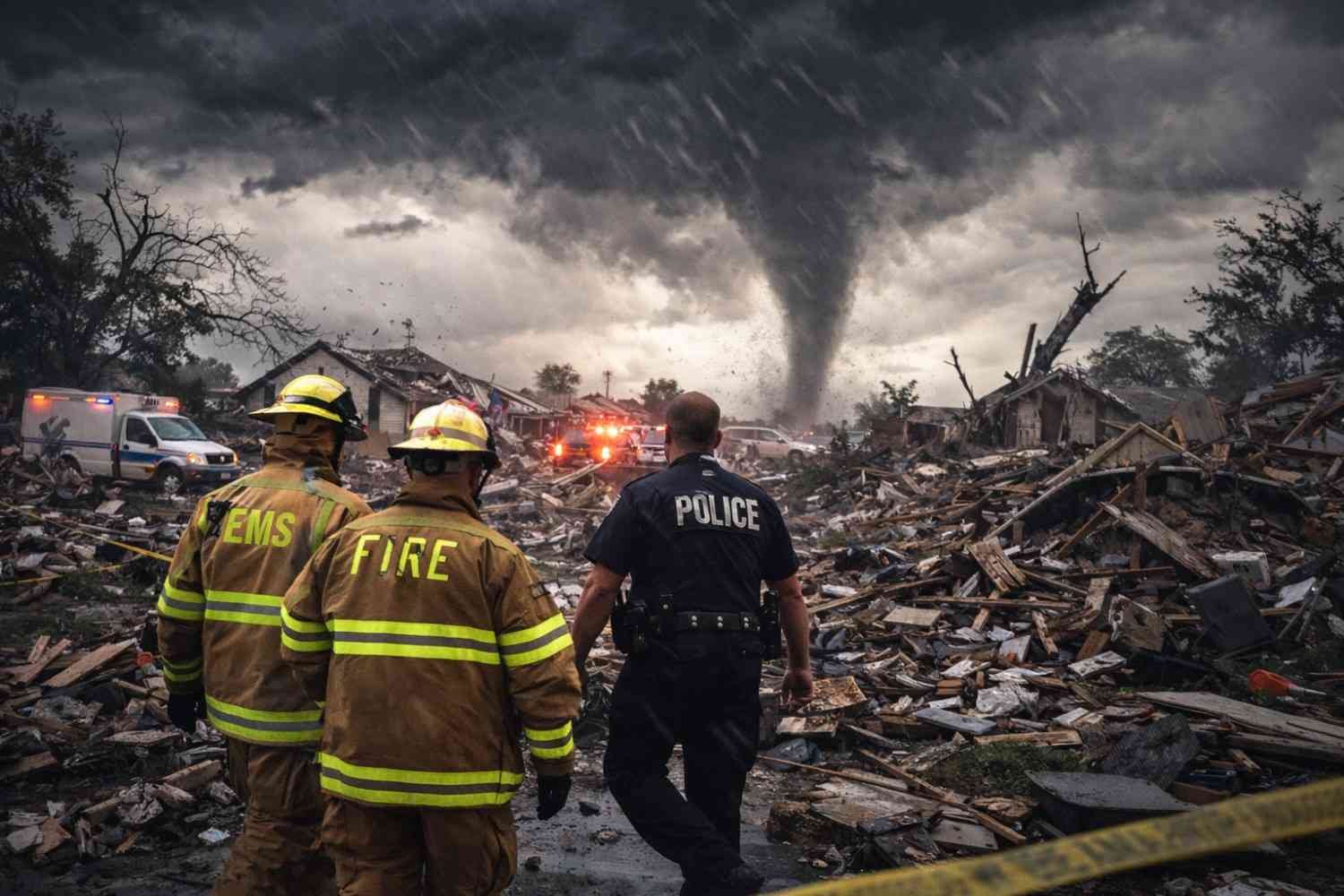
US tornadoes today have killed at least eight people across Michigan and Oklahoma in one of the deadliest early-spring outbreaks in recent memory. The storms tore through towns between March 5 and 7, 2026, shredding homes, flipping cars, and leveling entire neighborhoods in a matter of seconds. Among the dead is a 12-year-old boy. Dozens more were injured. And recovery crews are still pulling through the wreckage right now.
This was not a normal tornado outbreak. In fact, meteorologists say the combination of factors that produced these storms was unusually dangerous for early March — and the lack of advance warning made it even more deadly.
US Tornadoes Today: What Happened in Michigan
The worst of the US tornadoes today struck southern Michigan on the afternoon of Friday, March 6. A single supercell thunderstorm tracked northeast across three counties — Branch, Cass, and St. Joseph — producing a series of tornadoes in rapid succession.
The most powerful of those tornadoes was an EF-3 that slammed the Union Lake area just west of Union City in Branch County. According to the National Weather Service, that tornado carried winds of at least 150 miles per hour. It killed three people and injured 12 others. One of the victims was identified as Penni Jo Guthrie, 65, of Union City, whose home on Union Lake was completely destroyed by the storm.
Drone footage released by Michigan State Police showed the full scale of the destruction. Homes near Union Lake were swept entirely off their foundations. Cars were crushed under uprooted trees. Streets disappeared under mountains of debris. Witnesses described hearing a freight train sound just before the storm hit.
Meanwhile, in Three Rivers — about 25 miles southwest of Union City — an EF-2 tornado tore through the town’s commercial strip. Dramatic video from inside a Cricket Wireless store showed the twister ripping the roof off a nearby Menards store and demolishing a Dollar Tree. The tornado injured 10 people and caused significant damage across multiple businesses along the US-131 corridor.
In neighboring Cass County, near Edwardsburg close to the Indiana state line, a fourth fatality was reported on Saturday. That victim was a 12-year-old boy. His parents called 911 during the storm after they could not find their son. By the time first responders arrived, his parents were already giving him first aid. He later died from his injuries. That detail stopped me cold when I read it. A 12-year-old. A family searching for their child in the middle of a tornado. It is almost impossible to process.
In total, the Michigan storm system killed four people and injured at least 22 others. Michigan Governor Gretchen Whitmer declared a state of emergency in Branch, St. Joseph, and Cass counties. She activated the state’s Emergency Operations Center to coordinate rescue, debris clearance, and power restoration efforts.
Furthermore, power outages hit thousands of homes and businesses across the region. Indiana Michigan Power reported roughly 5,500 outages. Midwest Energy and Communications cited another 1,300 customers without power. Consumers Energy set up a mobile command center in Union City to help restore electricity.
What Made These US Tornadoes Today So Unusual
One of the most striking aspects of today’s US tornadoes was how unexpected they were. According to the National Weather Service, no tornado watch or severe thunderstorm watch was ever issued for Michigan before the storms hit. The outbreak was concentrated in a tight three-county area, which made it extremely difficult to detect far enough in advance for a watch to be issued.
As a result, many residents had little to no warning before the tornadoes arrived. That lack of advance notice almost certainly contributed to the death toll.
The Washington Post reported that a deadly tornado in Michigan in early March is extremely rare. Meteorologists noted that unusually warm air for this time of year, combined with a surge of energy from a shift in the jet stream, created the volatile atmospheric conditions needed to generate powerful tornadoes months before the traditional peak of tornado season.
In fact, meteorologists noted that the Union City tornado was tagged with a rare “particularly dangerous situation” designation — a classification the National Weather Service uses only for the most severe and life-threatening tornado events. That designation is not issued lightly.
US Tornadoes Today: The Oklahoma Devastation
The Oklahoma chapter of this outbreak actually began a day earlier. On the evening of Thursday, March 5, a powerful supercell tracked for hours through northwestern Oklahoma into Kansas, producing multiple tornadoes along its path.
The deadliest moment came near the town of Fairview in Major County. A mother, 47, and her teenage daughter, 13, were driving near the intersection of State Highway 60 and 243 Road when a tornado struck their vehicle. The force of the impact threw the car into a nearby field. Both were killed. Oklahoma Governor Kevin Stitt said he was praying for their family and for all those affected by the storm.
Then on Friday, a separate outbreak struck eastern Oklahoma. An EF-3 tornado hit the city of Beggs, about 30 miles south of Tulsa in Okmulgee County. Two people were killed and two others were taken to a hospital. The tornado cut a path of destruction roughly four miles long. Large trees were toppled throughout the area and widespread power outages were reported.
Jeff Moore, Okmulgee County’s emergency manager, described the chaotic hours after the storm. “We’re just getting everywhere as fast as we can, clearing roads as fast as we can,” he said. One resident, James Hall, described watching the tornado approach his home before grabbing his children and fleeing. In the aftermath, the roof of a nearby house had collapsed directly onto a car in his driveway.
In total, Oklahoma recorded four deaths across the two-day outbreak — the mother and daughter near Fairview, and two more in Beggs.
The Full Toll: Eight Dead, Dozens Injured
Across both states, US tornadoes today claimed at least eight lives and injured dozens more. According to Al Jazeera, rescue workers warned on Saturday that the death toll could still rise as damage assessments continued. At the time of writing, some areas had not yet been fully searched.
The outbreak also produced tornadoes in Texas and Arkansas. According to Wikipedia’s 2026 tornado tracker, an EF-2 tornado struck near Prospect in Marion County, Texas, injuring two people. Another EF-2 hit near Willisville, Arkansas, destroying a trailer and injuring one person.
In all, the March 5-7 outbreak produced some of the most significant tornadoes of the year so far — despite coming weeks before the traditional start of peak tornado season in late April and May.
Why Early March Tornadoes Are So Dangerous
Most Americans associate tornadoes with spring and early summer. However, the US tornadoes today are a reminder that severe weather does not follow a calendar.
Early-season tornadoes are often more dangerous for several reasons. First, people are less mentally prepared for tornado threats in early March than they are in April or May. Second, trees still have no leaves, which means less natural wind buffering but also clearer paths of destruction. Third, as this outbreak showed, the atmospheric setup can develop and move fast — leaving forecasters with a very narrow window to issue warnings.
Moreover, climate scientists have been tracking a broader trend. Research suggests that tornado season in the United States has been gradually shifting earlier in the calendar year and expanding geographically beyond the traditional Tornado Alley. The New York Times noted this week that Michigan experiencing a deadly tornado in early March is extremely rare — and that this event fits a pattern of unusual severe weather showing up in places and times where it historically has not been common.
Recovery Underway Across Affected Communities
As of Sunday March 8, recovery efforts are underway across all affected communities. Damage assessment teams from the National Weather Service have been working through the hardest-hit areas to confirm tornado ratings and map the full extent of the destruction.
In Union City, residents have been urged to avoid affected neighborhoods while crews clear debris and restore utilities. Several roads remain blocked. In Three Rivers, businesses along the commercial strip are assessing damage. In Beggs and the surrounding area in Oklahoma, tree removal and power restoration crews have been working around the clock.
Patricia Polacco, a well-known children’s book author who lives in Union City, posted a message to her followers after the storm. Her home, studio, and barn survived the tornado intact — but she urged her community to pray for those who were not so lucky. “Say prayers, especially for those families that have just endured the most horrifying loss of their life,” she wrote.
The Federal Emergency Management Agency is monitoring the situation. However, no federal disaster declaration has yet been issued.
What Comes Next
The severe weather threat has not fully passed. According to the National Weather Service, the storm system that produced the US tornadoes today continued moving east through the weekend. Tornado watches were issued for parts of Ohio, New York, Pennsylvania, and West Virginia on Saturday evening.
Additionally, a separate storm system is forecast to bring renewed severe weather risk to parts of the central US later this week. Forecasters are urging residents across the Midwest and Southeast to stay weather-aware and have a plan in place.
If there is one lesson from this outbreak, it is this: tornadoes can strike with almost no warning, at any time of year, in places that rarely see them. Having a plan before the storm arrives is not optional. It can be the difference between life and death.